There is a particular kind of conflict that no treaty has ever fully resolved. Not because the diplomats weren’t skilled, or the maps weren’t precise, or the borders weren’t drawn carefully enough. The real problem runs deeper than any of that. These conflicts don’t end because they were never really about the land in the first place. They were about what the land meant. And meaning, as it happens, is something the human brain manufactures in two completely different ways.
To understand why some pieces of ground stay contested for thousands of years, you have to understand something a little uncomfortable. Two different parts of the brain are fighting over them. And neither one of them is built to lose.
The Brain That Remembers
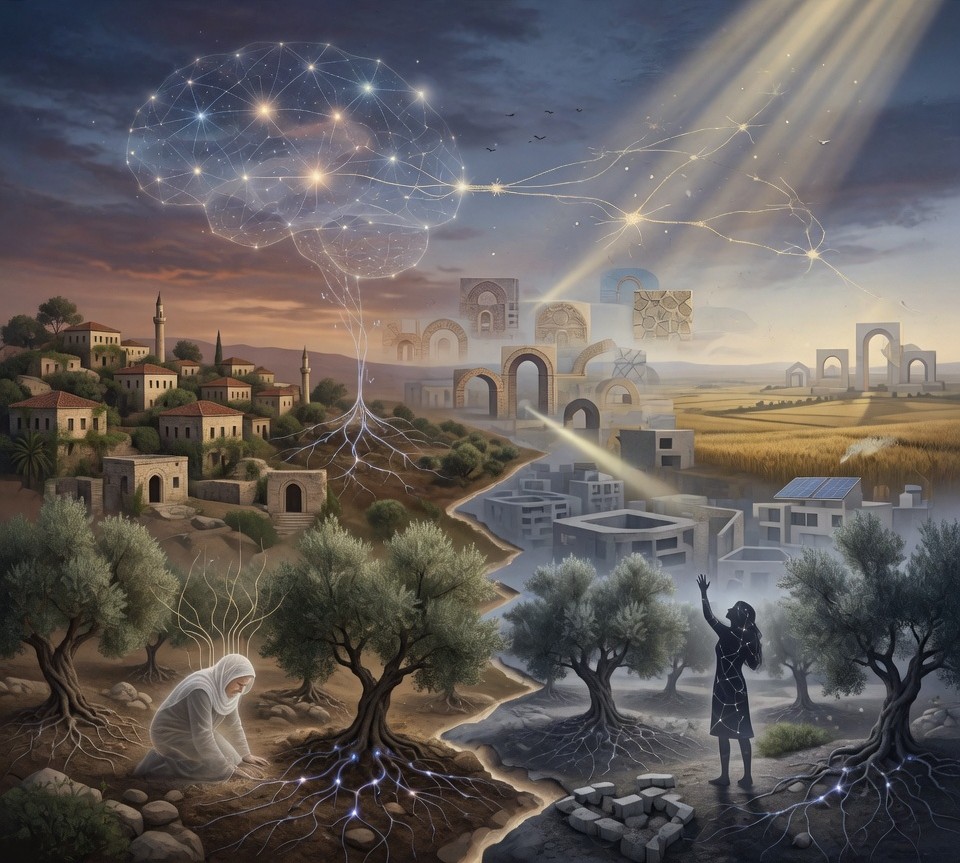
Deep inside the human skull, tucked into the temporal lobe, sits a small seahorse-shaped structure called the hippocampus. Most people know it as the seat of memory. What fewer people realise is that it is also, in a very real sense, the part of the brain that knows what home is.
The hippocampus stores the sensory architecture of belonging. The smell of bread baking in a particular kitchen. The way morning light falls across a specific tile floor. A mother’s voice calling from behind a stone wall. The sound of a television your grandfather always left on too loud. None of these are facts you sat down and memorised. They were encoded slowly, woven into the brain’s deepest map of who you are and where you came from.
This is part of why displacement is so devastating. When a person is forced from their home, the loss isn’t just material. It’s neurological. Researchers studying refugees and displaced populations have documented something close to a limbic injury, where the brain’s emotional system literally seems to mourn the loss of place. Home, to the hippocampus, isn’t a building. It is the storage medium for the self.
Take that away, and something inside the person breaks in a way that is very hard to repair.
The Brain That Dreams Forward
Now move to the front of the skull, behind the forehead. The prefrontal cortex is the part of the brain that handles abstract reasoning, future planning, and, crucially, destiny.
When humans engage with stories of prophecy, inheritance, and sacred return, the prefrontal cortex lights up. This is the brain region that imagines a place a person has never actually seen and treats it as already their own. It encodes the idea of a promised land. Somewhere a person hasn’t lived but feels covenantally entitled to. A future fulfilment. An ancestral right preserved across generations through story, scripture, and ritual.
This is more than belief. It is neurobiology shaped by mythology over thousands of years.
Here is where it gets interesting. The prefrontal cortex doesn’t process a “promised land” as fantasy. It encodes that idea using the same machinery the brain uses for real future planning. The same systems that help you imagine your career, your children, your retirement. Which means the brain treats prophesied inheritance as something genuinely real and emotionally binding, even when no foot has ever walked the soil.
Two brains. Two completely different ways of owning a piece of ground. One remembers backwards. The other dreams forwards.
When They Meet on the Same Soil
Now imagine these two systems pointed at the same patch of earth.
One people experiences the land as the storage medium of their entire identity. The olive trees their grandparents planted. The routes their children walked to school. The cemeteries that hold their dead. Hippocampal. Lived. Sensory. Home.
Another people experiences the same land as the fulfilment of a covenant carried across millennia. A future encoded in scripture. A destiny owed. A return prophesied. Prefrontal. Anticipated. Sacred. Promised.
Both are real. Both are neurologically valid. And both are defended by some of the deepest systems in the human brain.
This is part of why the political map keeps failing to resolve the dispute. It isn’t really a map problem. It’s a brain problem. A promised land rising on top of someone else’s home is not just a political collision. It is a collision between two of the most powerful structures in human cognition. Neither of those structures is wired to compromise.
And Then the Manipulators Arrive
If the story ended there, it would be tragic enough. But it doesn’t end there.
Because wherever two human cognitive systems are colliding this violently, a third group always seems to show up. Those who understand the science of belief better than the believers themselves.
Modern warfare is no longer fought primarily with tanks and territory. It is fought with narrative. The Russian military doctrine of maskirovka, a layered system of feints, propaganda, camouflage, and misdirection, is essentially the construction of alternate realities. Western powers run psychological operations that target populations at the emotional and symbolic level, shaping what people feel before they decide what they think. Both sides increasingly use AI models trained on real-time neurological feedback to guide entire populations into specific emotional states.
This isn’t some side feature of modern conflict. It is increasingly the main feature. War has become narrative engineering. The relentless shaping of belief until blood follows.
And sacred ground is the ultimate stage. A place where two cognitive systems are already locked in collision is the perfect canvas for manufactured reality. The hippocampus mourns. The prefrontal cortex dreams. And somewhere above both of them, players who understand exactly how memory and destiny work are moving pieces across a board the believers cannot see.
The Land That Holds the Question
The strip of land between the Jordan River and the Mediterranean Sea is, at the surface, a political dispute. One step deeper, it is a neurological collision between two brains that cannot share the same soil. One step deeper still, it is a stage on which much larger players are running simulations the rest of us mistake for history.
To understand the world we actually live in, you have to be willing to hold all three layers at once. The political. The neurological. The manufactured.
Most analysis stops at the first. Some serious work pushes into the second. Almost no one tells the story of the third.
If this is the kind of question that pulls at you, what happens when memory, destiny, and manufactured reality collide on the same patch of ground, then it is also the question at the heart of Homecoming, a novel that follows four worlds converging on a single ridge north of Jerusalem. A scientist who finds a signal the Earth shouldn’t be sending. A Russian team chasing a relic older than the conflict itself. A family in Gaza pulled towards the hills by a voice they cannot explain. And the intelligence operators watching all of them from rooms that don’t officially exist. Some books explain the world. Homecoming asks whether the world we think we are living in is the real one.